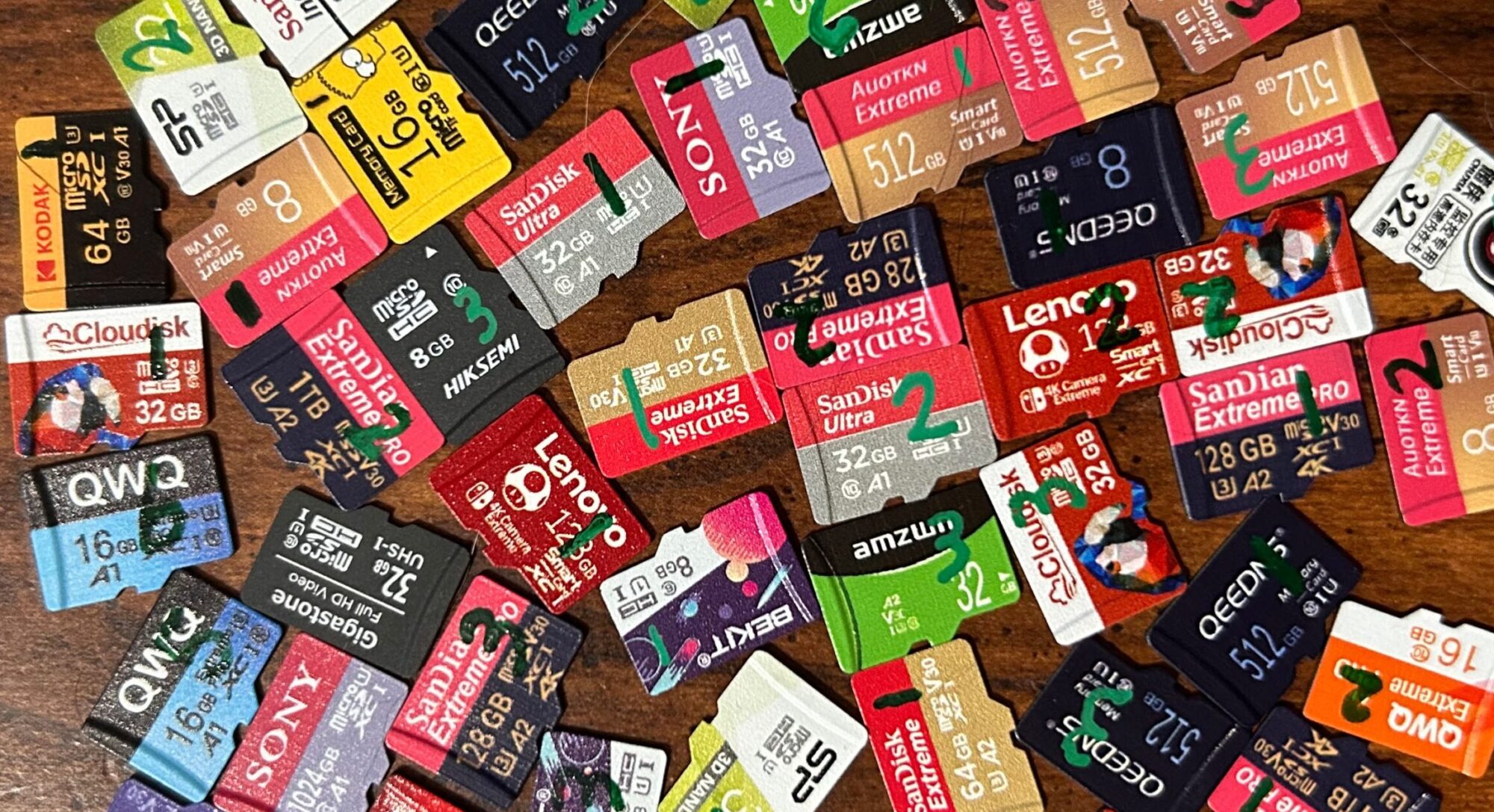
Ok, this has to be one of the weirdest trio of cards I’ve reviewed so far.
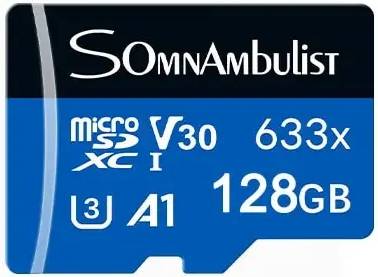
A number of new brands of questionable flash appeared towards the beginning of 2024, and this was one of them. I imagine that they’re trying to mimic Lexar, since the design mirrors that of the Lexar Blue 633x (including the “633x” mark). But what really made them weird? The fact that all three are different sizes — and none of them is 128GB. Rather, they’re all somewhere between 95GB and 102GB. I would have understood if the CSD register indicated that they were 128GB but had turned out to actually be 16GB — in fact, the product name in the CID register is “SD16G”, which I’ve only ever seen associated with 16GB cards — but that wasn’t the case here. They are the size that the CSD register says they are.
These cards failed the criteria that I set out for determining what’s considered a name brand card for a few reasons:
- The card came in a “retail” package, but the package doesn’t identify who the vendor of the card is.
- As far as I can tell, Somnambulist only makes microSD cards.
- As far as I can tell, Somnambulist doesn’t have a website.
- The information in the card’s CID register shows evidence that whoever manufactured this card was trying to conceal the their identity — specifically, the manufacturer ID and OEM ID are set to hex
00and hex3432, respectively.
The card doesn’t meet any of the criteria I set out for being considered a knockoff card, so these cards will go into the off-brand bucket in my results.
On the performance front…well…sample #1 got the lowest sequential read/sequential write scores of any card I’ve reviewed so far — primarily due to the fact that it failed to break even 1MB/sec in either one — and the second worst random read score. Samples #2 and #3 did better, but were still below average in 3 out of the 4 categories — only scoring above average in sequential read speeds.
These cards bear the U3, V30, and A1 performance marks. None of them performed well enough to qualify for any of these marks.
On the endurance testing front:
- Sample #1’s first error was a single bit flip, in a single sector, during round 768. It has survived about another 1,500 read/write cycles before it made itself read-only.
- Sample #2’s first error was a string of bit flip errors affecting 120 sectors during round 204. It survived 3,049 read/write cycles before it made itself read-only.
- Sample #3’s first error was a 1,152-sector wide data verification error during round 34. It continued to work just fine until round 2,050, when it made itself read-only. Up to that point, less than 0.01% of the sectors on the card had failed.
My verdict? Their size is unpredictable, they’ve got some of the worst skimp I’ve seen, one of them got the worst sequential I/O speeds of any card I’ve tested, and they’re well below average in endurance. They’re garbage — don’t buy them.
(On a random side note, it was pointed out that the word “somnambulist” roughly means “someone who sleepwalks”. It definitely felt like there was some sleepwalking involved in the creation of these cards.)
November 9, 2025